
Client: Industrial Specialty Chemicals Facility
Location: Southeastern United States
Services: Hazard Identification, Vendor Coordination, Field Oversight, Vapor Control, Bulk-to-Package Transfer
Background
An industrial specialty chemicals facility identified an off-spec tanker containing arsenic-bearing wastewater following an attempted outbound disposal shipment. During transportation, the material exhibited unexpected chemical behavior, including the generation of nitrogen oxide vapors, which resulted in the receiving treatment, storage, and disposal facility (TSDF) declining acceptance of the load.
The tanker was returned to the facility for further evaluation and corrective action. Although the material remained fully contained, the off-spec condition significantly elevated the risk profile associated with any subsequent handling or transfer, particularly due to the potential for additional vapor generation during agitation or exposure to air.
WTS was engaged to assess the situation and manage the safe resolution of the tanker contents. The primary objective was to complete the transfer under tightly controlled conditions, mitigate vapor hazards, and prepare the tanker for compliant over-the-road transport, all without release, injury, or environmental impact.
WTS assembled and coordinated a team of specialized subcontractors, each selected for specific technical capabilities required to manage liquid transfer and vapor hazards.
Hazard Identification and Planning
Early assessment confirmed that this was not a routine bulk transfer. Key risks included:
- Potential generation of toxic NOx vapors during transfer
- Confined headspace reactions in receiving containers
- Multiple hose connections and changeovers increasing failure points
- Environmental exposure risk during tote swaps
WTS approached the project as a controlled chemical operation rather than a standard logistics exercise. Supplier selection focused on demonstrated experience with acidic wastewater, vapor control, and high-hazard transfers, not just availability.
Supplier Selection and Oversight
From a pool of qualified suppliers, WTS assembled a purpose-built response team with clearly defined roles:
A specialized hazardous waste transfer contractor was selected for liquid handling based on demonstrated experience transferring acidic wastewater with multiple D-code characteristics, including arsenic-bearing streams.
A specialized vapor control and air monitoring contractor was selected to manage reactive off-gassing, provide continuous multi-gas monitoring, and actively scrub nitrogen oxide vapors during transfer operations.
A WTS Environmental Manager provided on-site oversight, drawing on a strong chemistry background and prior experience managing complex waste operations at similar industrial facilities.
This separation of responsibilities ensured that liquid handling and vapor management were addressed independently but operated in lockstep.
Connection Integrity and Transfer Controls
Before any transfer began, all hose assemblies and fittings were inspected. Camlock connections were verified for proper gasket installation and fully seated locking arms. As an added safeguard, zip ties were installed on camlock dog ears to prevent accidental disengagement due to vibration or hose movement. This simple secondary restraint eliminated a common but often overlooked failure mode.
Valves were clearly oriented and accessible, allowing rapid isolation if conditions changed.

Controlled Transfer and Environmental Isolation
Transfers from the tanker to totes were conducted one tote at a time within a dedicated bermed containment area. The liquid handling contractor configured the transfer using a temporary double block and bleed arrangement to maintain positive isolation between the tanker, the receiving container, and the environment.
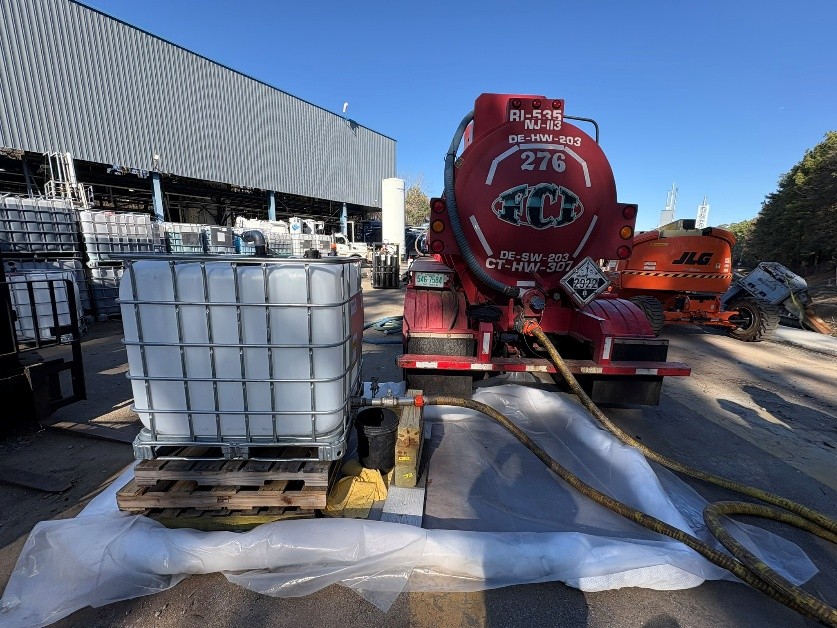
An acid-rated transfer hose was connected to the tanker outlet valve, followed by a rigid pipe section and a downstream isolation valve at the tote connection. This configuration allowed operators to stop flow, isolate the system, and drain residual liquid from the intermediate section into a pail before disconnecting hoses during tote changeovers.
This design eliminated drips and uncontrolled releases between transfers and ensured all connections and disconnections occurred under fully contained conditions. Work areas remained clean, orderly, and stable throughout the operation.
Vapor Monitoring and Scrubbing
The vapor control contractor deployed a multi-gas air monitoring system capable of continuously tracking NO, NO₂, NOx, SO₂, CO, and related compounds. The instrumentation was purpose-selected for this application to provide continuous multi-gas monitoring of nitrogen oxides and related compounds, rather than relying on handheld spot-check measurements.
Air monitoring was continuous, not periodic. Readings informed operational pacing, dwell times, and scrubbing duration.
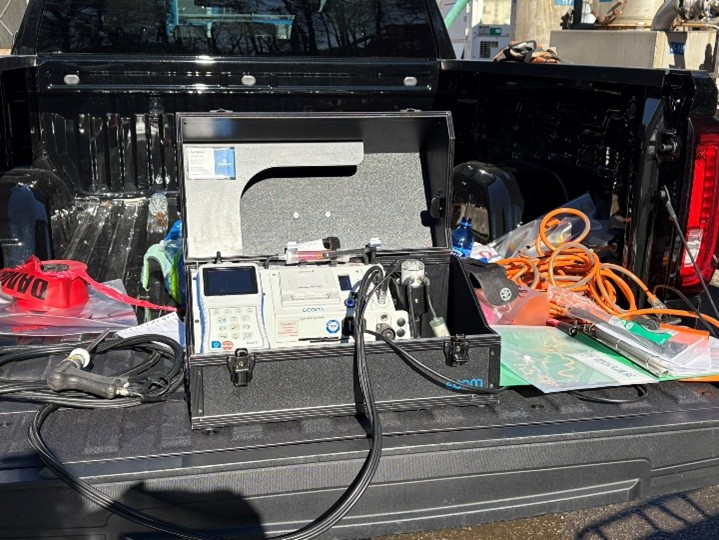
After each tote was filled, a 15- to 30-minute dwell period was observed. During this time, the vapor control contractor actively scrubbed vapors from the tote headspace. With each successive transfer, the headspace gas became visibly darker orange-brown, indicating NOx accumulation. Scrubbing continued until the headspace cleared before the tote was sealed and staged.
The behavior was consistent with a reactive system: as material was transferred, gas generation increased, then subsided once the reaction was exhausted. Transfers did not resume until air monitoring confirmed safe conditions.
Tanker Decontamination and Release
Once the tanker was fully emptied, the liquid handling contractor rinsed the interior through all three top manways. Simultaneously, the vapor control contractor pulled air through the open manways and scrubbed vapors continuously, preventing off-site migration.
Following rinsing, the manways were left open overnight to allow passive ventilation under controlled conditions. After verification, WTS notified the transporter that the tanker was safe and ready for over-the-road travel.
Results
- No vapor releases
- No spills or drips
- No injuries
- No environmental impact
- The tanker was returned to service without further restriction, and no follow-up corrective actions were required.
The operation was completed deliberately, without incident, and without reliance on emergency response measures.
Why This Matters for Complex Waste Management
Not all waste challenges are programmatic or predictable. When materials move off-spec or behave unexpectedly, risk can escalate rapidly if handled as a routine logistics exercise. In this case, uncontrolled vapor generation had the potential to create immediately dangerous to life or health (IDLH) conditions, requiring a disciplined, chemistry-driven response.
WTS approached this event with the same rigor applied to long-term waste management programs: early hazard recognition, deliberate planning, and coordination of specialized partners under experienced oversight. By integrating liquid handling, vapor control, and continuous monitoring into a single controlled operation, WTS ensured the situation was resolved safely and without impact. This capability reinforces WTS’s role as a technical partner for complex waste challenges, whether strategic or acute.